 1 month ago
47
1 month ago
47
 Image source, BBC Sport
With eight games left the Ekstraklasa, the Polish league, remains the most intriguing and exciting in the whole of Europe.
The table is so tight that the title race and the fight to survive relegation looks like going to the wire, with teams battling for Europe still also looking over their shoulder at the relegation zone.
Just 15 points separate leaders Lech Poznan (44 points) from 17th-placed Widzew Lodz (29), who are one place off the bottom and in the drop zone with three teams facing relegation.
Motor Lublin sum it up: seventh place, seven points off the top, but also just seven above relegation.
Even beyond the league, the wonderful chaos remains - this season's Polish Cup quarter-finals featured sides from the third and fourth tiers.
How did this extraordinary competitiveness happen? Is there anything to learn for other leagues out of the top six in Europe, with financial difficulties to compete?
While Poland's national team missed out on World Cup qualification with defeat by Sweden in Tuesday's play-offs, Guillem Balague looks at why their domestic football scene is flourishing again and whether it can last long term.
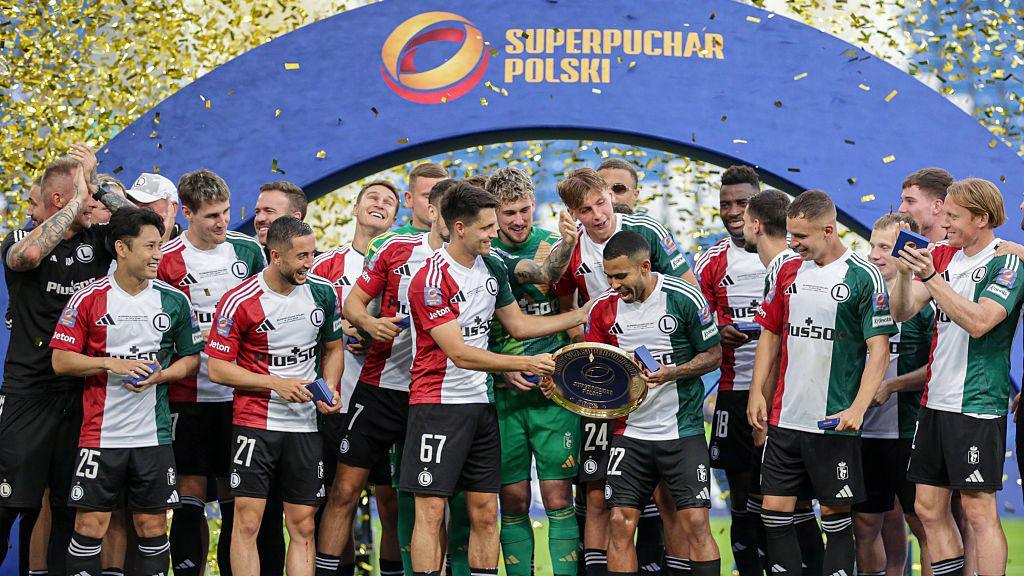 Image source, Getty Images
Legia Warsaw won the Polish Super Cup in July but are now only out of the relegation zone on goal difference
Poland has been described as Europe's "growth champion"., external Its economy is now the 20th largest in the world, with an annual output of more than $1tn (£751bn).
The progress in its footballing ambition has grown commensurately alongside this economic boom.
Poland as a footballing nation has been much more successful in the past but, after some recent dark times, there are real signs of hope again for their domestic league.
Michal Kolodziejczyk, head of sports for Canal+, the broadcaster and main sponsor of the Ekstraklasa, said: "Polish football was great in the seventies and eighties.
"Our fathers remember Poland as the third team in the world in 1974 and 1982. In the communist era, players couldn't go abroad to play.
"A great national team was built. In 1970, Legia Warsaw were in the semi-finals of the European Cup, losing to Feyenoord, and Gornik Zabrze were in the final of the Cup Winners' Cup.
"That era still weighs a lot. We would like to see our teams in the semi-finals of the European Cup again."
That may well still seem a step too far but in the 2022–23 season, while competing in the Uefa Conference League, Lech Poznan reached their first ever European quarter-final - where they were eliminated by Italian club Fiorentina. Other Polish clubs have since reached the knockout stages of Europe's third competition.
Polish football commentator Maciej Iwanski said: "That is when people started to realise that this is actually a proper league.
"The attendances started to rise very significantly season after season and people started to seriously follow their teams. They stopped being ashamed of the level of the football."
A huge growth in popularity
The average attendance at a Polish top league game this season was 13,674, which is 1,000 up from last season, and 4,500 more than what it was a decade ago. It is in its best state for the past 30 years.
The majority of Polish fans now support Polish clubs in Europe, irrespective of the club they follow domestically - as more income from European competitions benefits everyone.
Marcin Animucki, president of Ekstraklasa, said: "It all started with the foundation of Ekstraklasa as a professional entity, but the very big boost came after co-hosting Euro 2012. We have more than 25 new modern stadiums after that investment.
"When I joined the organisation, there were only one and a half million people coming to stadiums. Now it's more than four million, we are number eight in Europe according to fan attendance."
The fact that clubs are now privately run as opposed to being controlled by government institutions has also had a profound effect.
With more investment, better players are coming through the academies. The wages are high compared to neighbouring countries, apart from Germany.
The current deal with Canal+ is worth about £67m a year, small fry in comparison to the bigger leagues and about half what the Dutch league brings in. But it was a record four-year deal for the league when it was struck in 2023.
The Polish league has recently moved up from 18th to 12th in Uefa's coefficient standings, which means they will be entitled to five clubs in European competition next season.
Bizarrely equal - but is it a good thing?
The result of it all has been a bizarrely equal league.
The Ekstraklasa has had three new winners in the past decade, and five different winners in the past seven years.
Zaglebie, the league leaders until recently, are from tiny Lubin, whose 70,000 inhabitants ranks it outside the top 50 largest cities in Poland by population. They finished 15th last season, just one place above the relegation zone.
Legia Warsaw, the nation's biggest and most successful club, are only just above the relegation zone. Last season, they reached the Conference League quarter-final stage.
This season, big-spending Widzew Lodz have signed the three most expensive players in Ekstraklasa history, according to Transfermarkt, including Ghana international Osman Bukari from Austin FC for a reported £4.8m. They are currently in the bottom three.
Is the Ekstraklasa's unpredictability really a good thing though? The head of Canal+ is not entirely convinced, viewing it through the lens of long-term sustainability.
His model is clear: financially stable clubs, selling smartly, developing talent, and regularly reaching at least Europa League quarter-finals within five or six years.
Ultimately, he wants Polish teams in the Champions League group stage as a norm, not a surprise.
That, for him, means backing the best-run clubs - regardless of history - to compete in Europe. "For sure," Kolodziejczyk said. "What's the point of a competitive league if by the end of March we have no teams left in Europe?"