 1 month ago
48
1 month ago
48

This weekend sees the semi-finals of the FA Cup taking place between Manchester City and Southampton, and Leeds against Chelsea, both at Wembley Stadium.
Getting to Wembley is not just very special for any manager, it's still hugely important for the players, fans and all the staff at every club too.
There is always a debate about where the semi-finals should be played, but I know how much it will mean to be there this time, for everyone involved.
Whether it was the iconic Twin Towers or the famous arch, Wembley was the place I wanted to be - first as a player, and then as a manager - but It's a magic place for everyone involved.
When I took Gillingham to the old Division Two play-off final in 1999, the whole town was there. That was the old Wembley, though, which was crumbling by then. I remember me and my staff just being sat on two old wooden benches on the touchline.
By the time I came back, for the 2011 FA Cup semi-final with Stoke, it was a totally different stadium and the modern arena it is today - but getting there still had the same effect on our fans - and me.
I have always been a traditionalist and absolutely loved the FA Cup semi-final matches at places like Villa Park, Stamford Bridge, Highbury or Old Trafford. All of those grounds created a fantastic atmosphere when divided into two different sections for each club's supporters.
Being Welsh, I have to add that the Millennium Stadium was the same when it was used for semi-finals or finals while Wembley was being rebuilt.
But having finally reached the semi-final that year, in my 34th attempt as a player or manager, I was never going to complain about having Wembley on the horizon instead.
The same feeling applied to our fans, and it all meant the magic of the FA Cup really struck me leading up to our semi-final weekend.
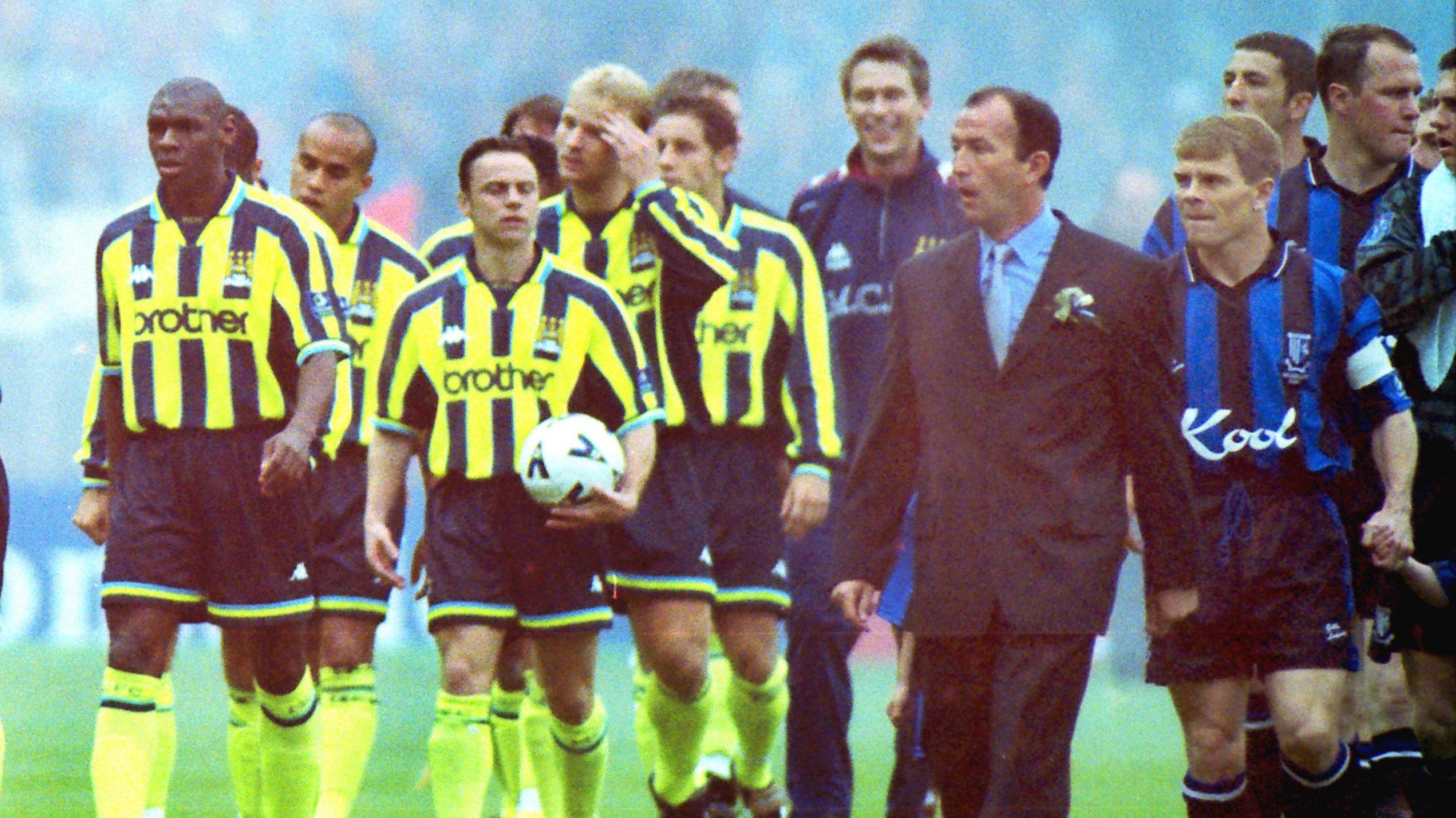 Image source, Getty Images
Pulis (front right) leads his Gillingham side out at Wembley for the 1999 Second Division (now League One) play-off final. They lost to Manchester City on penalties
A rousing speech by Gordon Banks
Over the years I spent at the club, I was always very keen to invite older Stoke favourites in to watch training on a Thursday, and then have lunch with the players.
The week before our win over West Ham in the quarter-finals that sent us to Wembley, I'd asked Gordon Banks, a Stoke legend and a World Cup winner, who had won at Wembley with the club in the 1972 League Cup final, if he would be prepared to do a speech.
He was delighted to be asked and gave a rousing speech about how wonderful it would be for all the players if they made it to Wembley, because he knew a lot of them had never played there before.
Stoke had only made it back to Wembley twice since 1972, for the Football League Trophy in 1992 and 2000, and Gordon also spoke about what it would mean for all our fans, young and old, to experience a trip down to the home of football.
He was right. We sold out our allocation for Wembley, with queues stretching for miles and I have to say it was such a great feeling to see so many happy faces around the city, with everyone buying into such a big occasion.
It was the same on the day too. I don't think anyone who was at Wembley for our semi-final win over Bolton will ever forget the tremendous din our supporters created from start to finish, and they played a big part in our win.
I'd treated the week of the game as a normal week, with the exception of Wednesday which was our usual day off.
That Wednesday, the lads met at Stoke train station in the morning and we travelled down to Euston, where we all jumped on a first-team coach and set off for Wembley Stadium.
We managed to not only get the bus into the stadium, but also get a quick walk on to the pitch - I wanted to do it because most of our lads had never even been to the ground, let alone played there.
I felt it was an important issue that needed addressing and I am sure the players benefitted from it. We rounded off the day by going to a local Italian restaurant and had dinner and a glass of wine, then came home.
I felt like we were ready for the semi-final, and things went our way on the big day too.
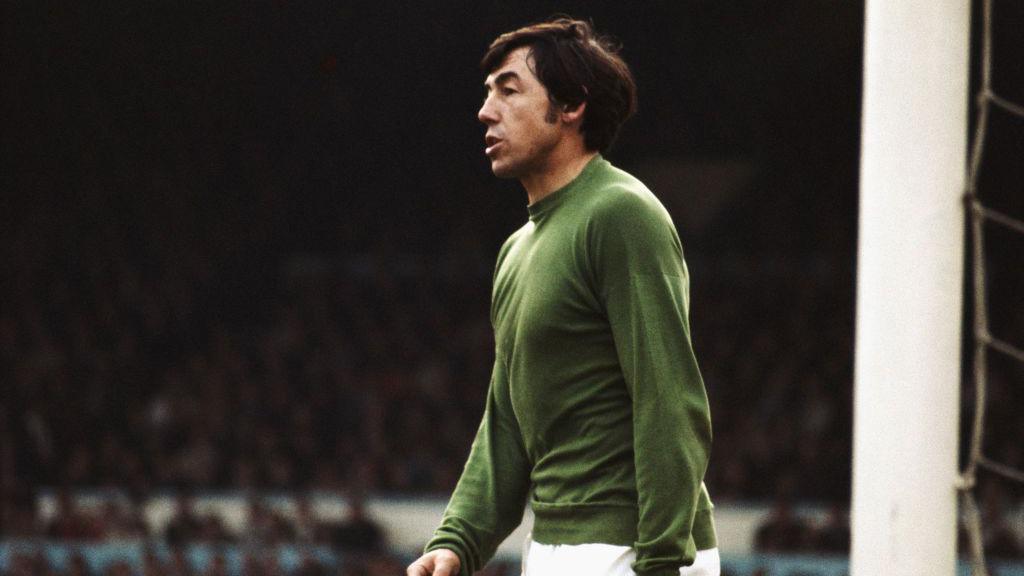 Image source, Getty Images
England goalkeeper Gordon Banks played 250 games for Stoke between 1967 and 1973, and he helped the club win their only major trophy when they beat Chelsea in the 1972 League Cup final
'My team-talk was taken care of'
I've talked in previous columns about how our cup run came together that year, and how you need a little bit of luck with the draw.
We'd had that already, because the only away tie we were given in the first four rounds was against Wolves, and it was the same for the semi-finals too.
The three other teams in the hat were the two Manchester giants, plus Bolton. I was convinced that both ourselves and Bolton would have to face United or City in the semi-final but fate was on our side - I know everyone at Stoke was delighted to get Bolton but I am sure Bolton were very happy to be paired with us too!
I've told the story before about how my skipper, Ryan Shawcross, had asked if the lads were getting new suits for the semi-final and I made him very aware of the fact it was not a final, and they had one more game to go before that happened.
We turned up in our tracksuits so when we saw the Bolton squad on the pitch, in suits and with flowers in their jackets, I turned to my assistant Dave Kemp and said that was my team talk taken care of - it was that significant.
We won the game 5-0 and every player who played that day deserves so much credit. It was an unbelievable performance.
It was a fantastic day for ourselves, our families and the supporters who to this day will always remember 'Delilah' being belted out by 50,000 Stokies.
Most of all, though, when I think of that day, I think of the Coates family, who have a deep love of the club through thick and thin, and over the years have invested enormous amounts of money on the club and the local community.
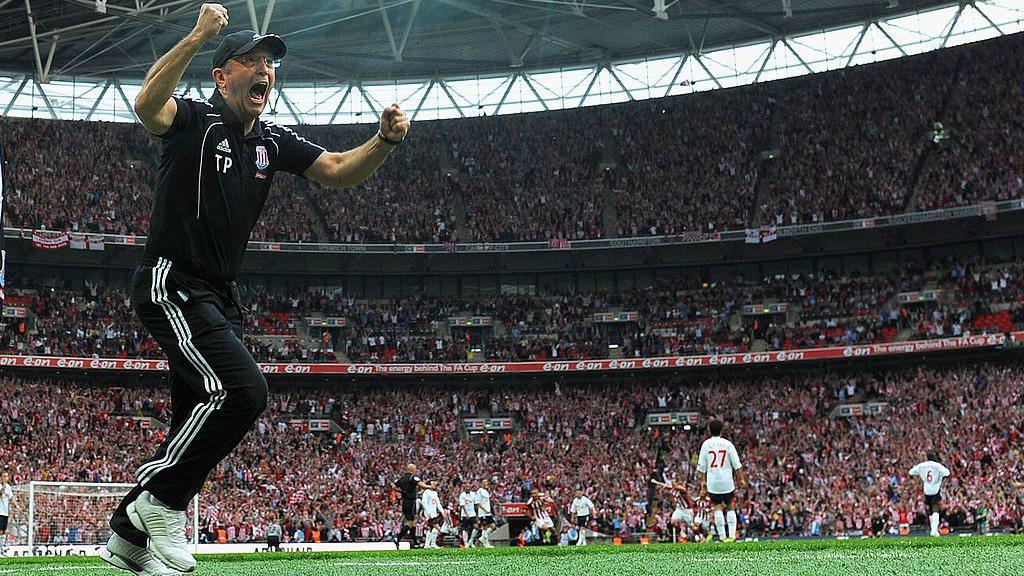 Image source, Getty Images
An FA Cup high, at Wembley. Pulis celebrates his side's fourth goal in their 5-0 win over Bolton in the 2011 semi-final
'A proud moment to make it to a final for real'
The prize for the winners at Wembley this weekend is the chance to go back there next month. Beating Bolton and making it to my first FA Cup final was absolutely huge for me personally.
Growing up in south Wales in the early 1960s, FA Cup finals, European Cup finals and World Cup games were the only times us youngsters - and anyone else - could watch live football on the TV.
Obviously I remember England's win over West Germany in 1966, but I was only eight at the time. The first FA Cup final I can remember was the following year, between Tottenham and Chelsea and strangely it sticks in my mind because I was watching on a black and white TV and found it impossible to identify the teams.
Spurs were in all-white, Chelsea wore all blue. It's probably not a problem many people have any more but, on our black-and-white TV, there was no difference in their kits.
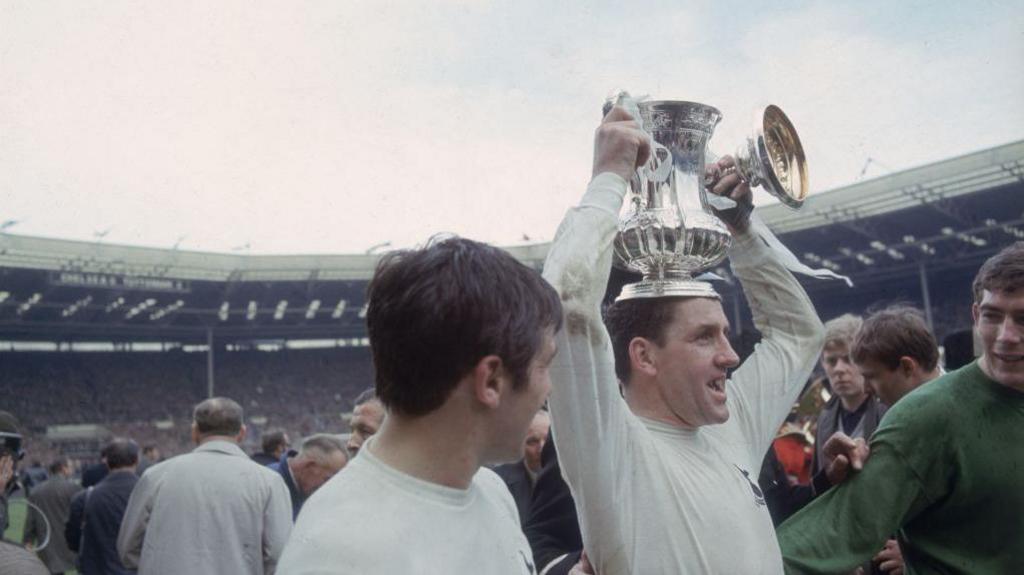 Image source, Getty Images
Tottenham captain Dave Mackay holds the FA Cup on his head as he celebrates Spurs' 2-1 win over Chelsea in the 1967 final at Wembley
In those days, the FA Cup commanded such a celebrated place in British football that thinking about it brings back so many rich memories for me.
As young lads in Newport, FA Cup final day started with around 20 of us playing a game over the old dock fields, with no bibs, no goals and no referee. It was cricket season so there were no goalposts either - instead coats were put down on the ground.
We'd run around for hours but I have no idea how we worked out which team we were all on, and I can't recall how we decided if there had been a foul or not either.
I don't even know how we decided when to stop, because none of us had watches in those days, but we never missed the final build-up to the FA Cup final or the game itself.
We'd do the same after the winners had lifted the trophy, going out to play again and mirroring the game we had just watched and recreating the goals as the players who had influenced the game. Right across the country, I am sure many of you did the same.
We would play on until the light started to fade, which indicated it was time to head home - again, I don't ever recall my mum or dad hurrying me in!
This went on year after year where I lived, even when TV began starting its coverage early on Saturday morning, with coverage from the teams' hotel, of supporters travelling or even what the players' wives were wearing.
None of that interfered with our own cup final, which we lived year after year, so it was a very proud moment to make it to one for real.
Walking out at Wembley for the 2011 final fulfilled my dream of taking a team to an FA Cup final. Sadly we lost 1-0 to an emerging Manchester City side but that result does not detract from the magic of the FA Cup - I can't wait to see what this weekend brings.
Tony Pulis was speaking to BBC Sport's Chris Bevan.