
Jordan ReidMar 7, 2026, 06:00 AM ET
- Jordan Reid is an NFL draft analyst for ESPN, providing in-depth scouting on the nation's top pro prospects. Jordan joined ESPN in 2021 and also contributes to SportsCenter and ESPN Radio. He played quarterback at North Carolina Central University and then went on to coach there from 2014-18.
We're inside two months until the 2026 NFL draft, as it kicks off April 23 in Pittsburgh. With the combine recently ending, I'm re-ranking the quarterback class. Who are the best passers on the board?
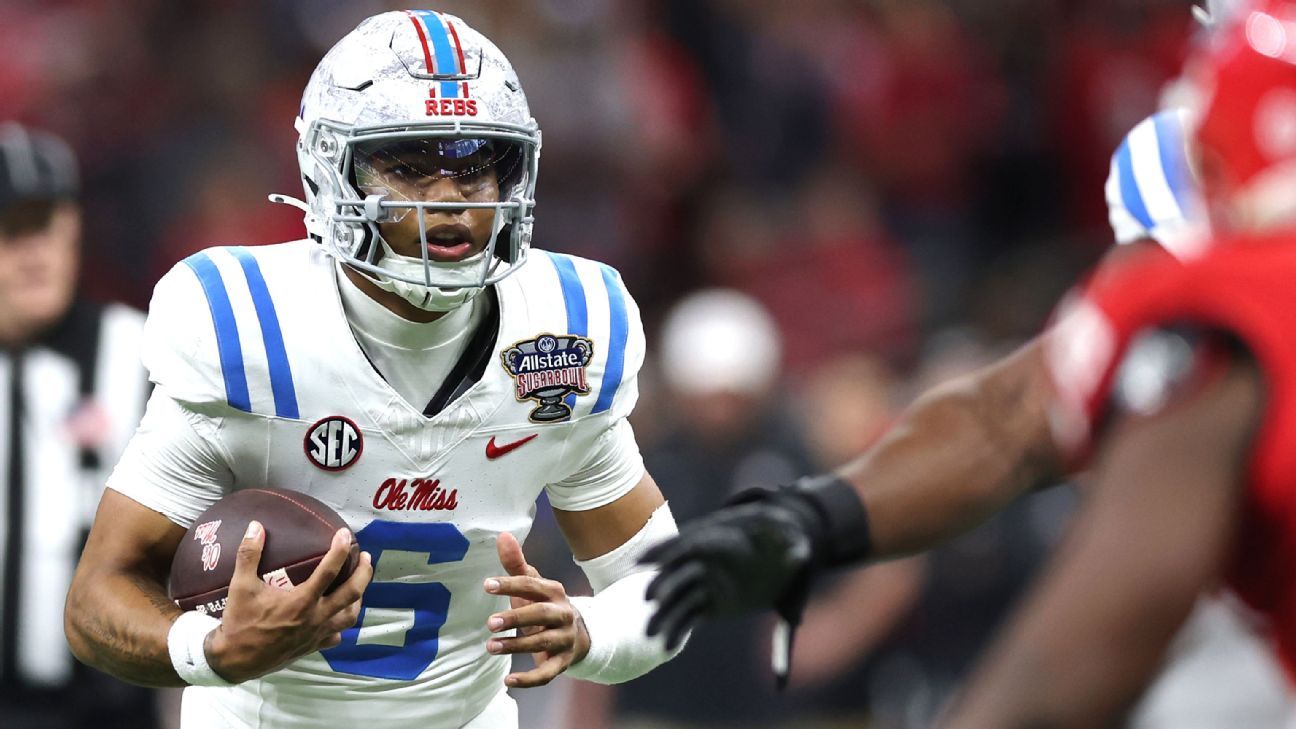
We made another tweak to this edition, as Ole Miss quarterback Trinidad Chambliss will be returning to college in 2026 after being granted an injunction to his eligibility case (although the NCAA is appealing). Heisman runner-up Diego Pavia takes his place on our list. But these rankings still aren't final, as pro days and top-30 visits are still to come.
Let's get to it and stack the 12 best QBs in the 2026 class as of now.
Jump to:
Day 2 picks | Day 3 picks


1. Fernando Mendoza, Indiana
Height: 6-foot-5 | Weight: 236 pounds
Class: Redshirt junior | Projected range: Round 1
Where he excels: There always seems to be a quarterback who quickly surges from Day 2-3 consideration before the season into early Round 1 (see Jayden Daniels and Cam Ward). Mendoza fills that role in this class. He transferred to Indiana last offseason after spending his first three seasons at Cal. There was plenty of buzz from scouts about Mendoza last summer, but many wanted to take a wait-and-see approach prior to the 2025 season. He delivered, finishing with 3,535 passing yards, 41 touchdowns and only six interceptions to win the Heisman Trophy and lead the Hoosiers to their first national championship.
Attaching isolated or singular routes behind run-game concepts has been beneficial for Mendoza, who is comfortable with reads that put single defenders in conflict. He has a fiery, three-quarters throwing release, making Mendoza's mechanics and the Hoosiers' passing game an ideal marriage. His 79.2% adjusted completion percentage ranked second in the country. He was also phenomenal in the red zone last season, with his 27 touchdowns (without an interception) being the most in the FBS, three ahead of Duke's Darian Mensah.
Toughness and overcoming in-game adversity are two of Mendoza's hallmark traits. He helped lead the Hoosiers to a Week 7 road win at Oregon, pieced together an 80-yard, game-winning drive at Penn State, and overcame Ohio State in a physical Big Ten championship game in which he was temporarily knocked out of the game early. He capped everything off with a gutty touchdown run for the game-winning points in the College Football National Championship game against Miami. It's as good of a résumé that a quarterback prospect can have from an adversity and toughness standpoint. That's why Mendoza is the overwhelming favorite to be picked by the Las Vegas Raiders with the No. 1 overall pick.
Where he needs work: While Mendoza is comfortable within the confines of the pocket, he struggles when forced off his original launch point. When required to move, Mendoza had a 53.2% completion percentage last season. Many of his inaccurate throws came when moved off his original launch point, flushed outside the pocket or forced into scramble situations. When facing true pressure, his completion percentage dropped to 50%.
Mendoza has separated himself as the top passer in this year's class, but one thing at the next level which will be relatively new is operating from under center. He played out of the shotgun almost exclusively last season, taking only 3% of his snaps under center. Working under center is important in the NFL, as it keeps defenses honest and helps further the influence of play-action on defenders, so Mendoza will have to work on those mechanics.

2. Ty Simpson, Alabama
Height: 6-foot-1 | Weight: 211 pounds
Class: Redshirt junior | Projected range: Late Round 1, Early Day 2
Where he excels: After a rough Week 1 performance, Simpson had a hot streak during the middle of his first season as a starter. During an eight-game stretch that included four top-16 ranked opponents (Georgia, Vanderbilt, Missouri and Tennessee), Simpson threw for 1,954 passing yards, 19 touchdowns and only one interception while completing 71.9% of his passes. Simpson showed that he's a calm passer with slightly above average arm strength and that there isn't much that fazes him in the pocket.
There isn't a throw that Simpson feels that he's incapable of making, as his toughness and confidence shined in spurts. The son of longtime UT-Martin head coach Jason Simpson, Ty's football smarts and awareness are easy to see. Simpson was given a lot of pre-snap autonomy and was frequently seen altering protections and plays. His recognition of defenses is well beyond a typical QB prospect with 15 career starts.
Simpson is an underrated athlete whose pocket maneuverability is among the best of any passer in this year's class. He also can make plays outside of structure. Of his 30 total touchdowns last season (28 passing, two rushing), seven came when Simpson was outside of the pocket. He's savvy with recognizing and adjusting to pre-snap looks.
Simpson elected to throw at the combine and helped himself after a disappointing finish to last season. He displayed good zip on passes in the intermediate areas, but what really stood out was his touch on deeper throws down the field.
"I wouldn't draft him until Day 2, but I think he has a chance to go in that 20-32 range," an AFC area scout said. "It's because the demand will highly outweigh the quality of supply in this year's class."
Where he needs work: Simpson sometimes doesn't recognize when a play is over. He tends to hold the ball longer than necessary and run around in circles in the pocket while trying to extend plays that are clearly busted. Therefore, he loses yardage with negative plays that could have been avoided by checking down, running or tossing the ball out of bounds.
Simpson's accuracy suffered down the stretch, resulting in an 11.2% off-target percentage that ranked 63rd in the FBS. And despite his combine long-ball prowess, Simpson completed only 37.3% of his passes of 20 or more air yards in 2025.
Simpson's lack of starts are also a concern. Many scouts remain cautious due to that small sample size.

3. Garrett Nussmeier, LSU
Height: 6-foot-2 | Weight: 203 pounds
Class: Redshirt senior | Projected range: Late Day 2, Early Day 3
Where he excels: Nussmeier entered the 2025 season with heightened expectations after a promising first year as starter. He showed flashes in 2024, throwing for 4,052 passing yards and 29 touchdowns. That had many evaluators believing that he had the potential to rise to the top of the 2026 QB class. But things didn't work out that way, as Nussmeier took a clear step back, with 1,927 passing yards, 12 touchdowns and five interceptions in nine games. He battled multiple injuries in 2025, including patellar tendinitis in his knee.
Nussmeier primarily operates from the pocket and plays with fearless anticipation. He throws accurately to spots in the intermediate game while showing an excellent gauge on route depth and where his receivers will finish on passing concepts. Nussmeier has a flexible arm, allowing him to easily alter his arm slots and ball trajectories to fit passes into spots. He navigates the pocket well, is aware of outlets and gets the ball out of his hand quickly.
Nussmeier entered the predraft process wanting to show he was healthy. He checked many of the boxes during Senior Bowl week, returning to his fearless anticipatory ways as a thrower. That's part of his appeal, as Nussmeier's arm power is below average, but he isn't afraid to stretch the limits of defenses and trusts his perimeter targets.
Where he needs work: Nussmeier was reduced to attacking primarily the short area of the field last season due to LSU's scheme of quick-hitters and frequent screen passes. While he gets to unleash the occasional go ball, he averaged only 6.4 air yards per target (130th in the FBS). LSU's running game being ranked 126th in the FBS didn't help matters, either.
He also has a propensity to be a daredevil, which can be a gift and a curse. Nussmeier has sporadic moments of carelessness because of his confidence in being able to anticipate. Many evaluators feel that Nussmeier has the profile of a middle-to-late round prospect who has the talent, awareness and mentality to stay in the league for more than a decade as a backup and eventually develop into a spot starter.

4. Carson Beck, Miami
Height: 6-foot-5 | Weight: 233 pounds
Class: Sixth-year senior | Projected range: Late Day 2, Early Day 3
Where he excels: Once regarded as a candidate to be the No. 1 pick in the 2025 draft, Beck's inconsistencies resulted in him entering the transfer portal after a disappointing final season at Georgia. But Beck started to revive his draft stock at Miami last season. A rhythmic passer who is at his best when allowed to play on-beat, he finished with 3,813 passing yards, 30 touchdowns and 12 interceptions. Even though one of those interceptions was on the final drive of the national championship game against Indiana, Beck found a great connection with Miami's playmakers and offensive line.
Beck was helped by a more consistent and improved receiving structure around him and looked more like what he showed in 2023 versus 2024. He is a balanced pocket passer who wants to methodically dissect and deliver against defenses. His game is centered around accuracy and decisiveness, so he wastes little time getting the ball out and remains synchronized with progressions. His 74.8% adjusted completion percentage last season was the eighth-highest mark among all FBS passers.
Many teams feel comfortable with the floor that he brings and view him as a strong middle-round option.
"We don't need a QB, but he's the favorite to be QB3 off of the board if we needed to take one," an NFC director of college scouting told me at the combine.
Where he needs work: Teams able to consistently generate early pressure against Beck have been able to knock him off his game. Beck's off-target percentage when his feet are planted (9.7%) last season was significantly different than when he's forced to move (21.4%) from his original launch point.
Beck needs to be drafted by a team where he's the final piece of the puzzle rather than one that lacks surrounding playmakers; he's more reliant on good infrastructure than most QBs. The Miami offensive line was key, as Beck's 17.1% pressure rate faced was the lowest in the FBS. He got an average of 2.9 seconds to throw the ball. Beck was able to play within the confines of the offense while not being forced to make plays outside of the scheme. But can he hold up when conditions are less ideal?

5. Drew Allar, Penn State
Height: 6-foot-5 | Weight: 228 pounds
Class: Senior | Projected range: Late Day 2, Early Day 3
Where he excels: Allar has prototypical size and arm strength. He's an above-average intermediate passer who isn't afraid to test tight windows and can accurately hit routes in between the numbers. He exhausts progressions and delivers to targets, and he has more than enough arm strength to succeed at the next level. He also has the mobility to navigate the pocket and gain yardage that's available.
He also has plenty of experience, having started 35 games and played in 45 overall. He made a noticeable leap from his sophomore to junior season, increasing his completion percentage from 59.9% in 2023 to 66.5% in 2024. Upon announcing his return to school prior to last season, Allar was immediately expected to be one of the best QBs in this class.
That didn't happen. A disappointing loss at home against Oregon in double overtime in which Allar threw the game-ending interception was followed by losses to UCLA and Northwestern. He suffered a broken left ankle in the Northwestern game and was sidelined for the season. Prior to the injury, Allar had 1,100 passing yards, eight touchdowns and three interceptions.
Evaluators were very complimentary of Allar's performance at the combine in his first post-injury action. The arm strength was easy to see, as the ball came out of his hand with plenty of energy behind it. His accuracy improved as the session progressed.
"I absolutely love that he came out and competed at the combine," an AFC area scout said. "He's been a bit of a mystery since the ankle injury, but I'm glad that he came out and proved that he was on the road to being back healthy."
Where he needs work: Allar's accuracy regressed last season, as his 12.5% off-target percentage ranked 94th in the FBS, and Allar has moments where he puts the ball too high or low. He tends to make receivers work harder than they should to secure catches.
"The biggest issue is that he looks good against the low- and middle-tier teams, but he just hasn't had that signature performance any time that he plays against the elite ones," an AFC assistant general manager said.
NFL franchises fall in love with physical tools. In what is a jumbled up group of QBs in Rounds 3 and 4, Allar has far and away the best physical traits of the bunch, but his accuracy has yet to improve. There likely will be a team that convinces itself that it has the right coaching to help Allar improve his mechanical flaws, so it shouldn't come as a surprise if he's drafted earlier than expected.

6. Cole Payton, North Dakota State
Height: 6-foot-3 | Weight: 232 pounds
Class: Senior | Projected range: Late Day 2, Early Day 3
Where he excels: Payton continues the long-running tradition of decorated North Dakota State passers. After missing the final eight games of the 2024 season with an injury to his non-throwing shoulder, he bounced back in 2025, finishing with 3,188 passing yards, 29 total TDs (16 passing, 13 rushing), and four interceptions.
Payton is a strong dual-threat option with a frame that allows him to make difficult throws from the pocket and showcase his ability as a runner. He is tough in the pocket and able to withstand big hits from defenders while still throwing accurately. Payton is an excellent downfield passer, as his strong base, touch and feel help him deliver drop-in-the-bucket passes. Designed QB runs and short-yardage situations are successful with him because of his vision and willingness to fight through and shrug off would-be tacklers.
Payton was the most consistent passer during Senior Bowl week. He showed consistency executing progressions, layering throws, and no hesitancy on tight-window throws over the middle of the field. Even though he's labeled as an athlete on some draft boards, Payton is a legitimate passer with upside. Because of the progress that he has shown during the predraft circuit, he's now a favorite middle-round target for teams looking for a project passer with upside.
"He was finally healthy this year prior to that game in the playoffs and I actually liked his film quite a bit," an AFC scout assigned to the Midwest said. "We thought he was more of a Taysom Hill-type with the ability to do more than just pass it around."
Where he needs work: Payton has a full-circle throwing motion that includes loopy mechanics. He must become less reliant on his upper body to generate power in his throws, as his lower body stiffness is most notable when throwing passes to his left side. Progressing to secondary options and overall pocket awareness are other things that he needs to improve. He also has a habit of locking on to first reads and being unaware of underneath targets. And finally, Payton also needs to use his mobility more by taking off to run when plays break down or when early options aren't available.
Payton suffered a broken thumb on his throwing hand during the team's second-round loss in the FCS playoffs.
7. Taylen Green, Arkansas
Height: 6-foot-6 | Weight: 227 pounds
Class: Fifth-year senior | Projected range: Early Day 3
Where he excels: In what was the best QB testing performance ever at the combine, Green ran a blazing 4.36-second 40-yard dash time, jumped 43½ inches on the vertical jump and 11-foot-2 in the broad jump. That type of athleticism consistently shows up on tape.
"If I have time to develop [a quarterback] over time, he's the one that I'd be willing to take a shot on," an NFC assistant general manager said. "There's a lot of creative things that you could do with him while he's developing, but that type of profile is what you typically like to take a chance on."
Green immediately became the Razorbacks' starter after transferring from Boise State following the 2023 season. He had 2,714 passing yards, 19 touchdown throws and 11 interceptions last season, along with 771 rushing yards (12th most among FBS QBs) and two touchdowns on the ground. He had eight games with 50 or more rushing yards. Green's long stride puts teams in a bind when he runs. Green also has the arm talent to get the ball to the spots he wants with his elongated over-the-top release.
He has shown the ability to make explosive plays with both his arm (14 completions of 20-plus air yards) and his legs. He will likely be a popular middle-round target for teams looking to develop a toolsy passer with upside.
0:30
Taylen Green recounts record-breaking combine performance
Arkansas' Taylen Green, a top-10 quarterback prospect, recounts his record-breaking NFL combine performance.
Where he needs work: Green's warts were noticeable as last season went on, most notably the time he takes to pass the ball. His 3.13-second average time to throw ranked 134th out of 138 quarterbacks in the FBS, and his indecisiveness in the short-to-intermediate areas was a big reason. Green has also struggled facing pressure. All 27 times he was sacked last season came against true pressure, and he completed only 38.6% of his passes in those situations.
Green's highs are extremely high and his lows will leave you scratching your head. His road to developing as a passer will be turbulent. Green undoubtedly has the necessary arm strength and mobility, but the inconsistent accuracy, footwork and timing all need a lot of coaching moving forward.

8. Luke Altmyer, Illinois
Height: 6-foot-2 | Weight: 210 pounds
Class: Senior | Projected range: Early-mid Day 3
Where he excels: After transferring to Illinois from Ole Miss in 2023, Altmyer became the starter in his first year with the program. He improved every season, finishing 2025 with 3,007 passing yards and 22 touchdowns to five interceptions. Altmyer is a true point guard who gets the ball out in a hurry, spreads it around and is a swift processor of opposing defenses. He does a great job identifying breakdowns or holes in defenses, and his 8.0% off-target percentage was the eighth lowest in the FBS.
Illinois' offense runs a mixture of light and heavy personnel sets, so Altmyer has gained experience with a variety of pre-snap positionings. He can play from under center or in the shotgun, operates well off play-action and can read out leveled concepts. He can also run when opportunities present themselves, showing the escapability and quickness to outrace first- and second-level defenders.
At the Senior Bowl, Altmyer displayed why many teams have interest in him as a later-round option. He kept the offense on schedule with efficiency, throwing in rhythm and showing the mobility to escape the pocket and make plays happen outside it.
Where he needs work: Altmyer's confidence can be a gift and a curse, as he'll bypass safer options in hopes of hunting for flashy plays. That daredevil mentality can prompt him to force throws into tight windows. Altmyer has a limited arm, but he's functional in schemes that allow him to attack off timing routes.
Many evaluators I spoke to last season mentioned him as one of their top candidates to be a late-round dart throw who could become a decade-plus backup quarterback in the NFL.

9. Cade Klubnik, Clemson
Height: 6-foot-2 | Weight: 207 pounds
Class: Senior | Projected range: Early-mid Day 3
Where he excels: With four starters returning along the Tigers' offensive line and his top three wide receivers back for another season, I thought Klubnik had the best supporting cast in the country and had a prime opportunity to build off a breakout 2024. That's part of why I had him as the No. 1 pick in my way-too-early mock draft last May. But Klubnik finished with 2,943 passing yards, 16 touchdowns and six interceptions. He's most comfortable operating off play-action, as he had 10 touchdowns, two interceptions and a 72.7% completion percentage.
Klubnik has stretches of hot and cold play throughout games, similar to a streaky 3-point shooter. His clean throwing release allowed him to distribute the ball evenly to all his targets in the underneath areas the Tigers operated in. Klubnik is also a threat as a runner when forced to break the pocket.
Where he needs work: Klubnik has a lot of borderline-average traits but doesn't have one superior trait. Outside of his Week 6 performance against North Carolina (22-of-24, 254 yards and 4 TDs), Klubnik hesitated throwing the ball on time, too. I saw him up close against LSU in the 2025 season opener and noticed that he had timing troubles when reading concepts. His anticipation skills have been lacking, and he defaulted to waiting for teammates to get open before throwing.
His mechanics tend to wane when facing pressure, and his accuracy becomes scattershot. Klubnik completed only 48.5% of his passes when facing true pressure. There were mixed opinions of Klubnik entering the season, but thoughts of him being a middle-to-late round passer have become more of a consensus.

10. Sawyer Robertson, Baylor
Height: 6-foot-4 | Weight: 216 pounds
Class: Redshirt senior | Projected range: Late Day 3, UDFA
Where he excels: Robertson has an effective throwing motion, which helped him distribute the ball in Baylor's spread-and-shred offense. After transferring from Mississippi State, he took the reins of the QB1 spot early in the 2024 season and orchestrated one of the more explosive units in the country the past two seasons.
Robertson finished his college career with back-to-back 3,000-yard passing seasons, with 3,681 passing yards, 31 touchdowns and 12 interceptions in 2025. He's always looking to attack vertically, as his 26 completions of 20-plus air yards were the 12th most in the FBS. Robertson is a quick, decisive decision-maker who gets the ball out in a hurry. He knows where his options are in passing concepts and shows a willingness to throw the ball to any accessible receiver, no matter where he is on the field.
Where he needs work: Robertson's accuracy and pocket feel can waver when defenses speed him up and his base isn't set. His 12 interceptions last season were tied for fifth most among FBS QBs, and Robertson had three games where he threw at least two interceptions. His decision-making would waver in the fourth quarter, when he threw six interceptions. Underthrown passes and misreading underneath coverages were the two major culprits in his turnovers and missed opportunities.

11. Joe Fagnano, UConn
Height: 6-foot-3 | Weight: 226 pounds
Class: Seventh-year senior | Projected range: Late Day 3, UDFA
Where he excels: A rare seventh-year senior, Fagnano spent four seasons at Maine (2019-22) before transferring to UConn prior to the 2023 season. He experienced a breakout in 2025, finishing with 3,448 passing yards and 28 touchdowns to only one interception -- a tipped pass against Air Force. Fagnano is a mechanically sound passer whose eyes, feet and throwing motion are routinely in sync. He shows comfort with scanning through full-field reads. He understands his limitations and opts to make the right throw. And he also gets the ball out quick -- his 2.56-second average time before pass ranked among the top 25 in the FBS.
Fagnano rose to the occasion against bigger opponents, going 2-1 against ACC opponents, including a victory over ACC champion Duke. His 14 go-ahead passing touchdowns led the FBS.
Where he needs work: Fagnano, who will turn 25 prior to the draft, played in an offense predicated on quick completions, as 28.8% of his attempts last season were at or behind the line of scrimmage (38th most in the FBS). He has limited arm strength and won't wow scouts with his passing velocity. His game is more dependent on taking the safe throw than testing defenses in tighter windows.

12. Diego Pavia, Vanderbilt
Height: 5-foot-10 | Weight: 207 pounds
Class: Sixth-year senior | Projected range: Late Day 3, UDFA
Where he excels: After two seasons in junior college, Pavia played two years at New Mexico State before transferring to Vanderbilt prior to the 2024 season. He was the catalyst behind one of the most magical program turnarounds in the country over the past two seasons. He finished with 3,539 passing yards, 29 touchdown passes and eight interceptions last season and was second in the Heisman Trophy voting.
His 8.8 yards per dropback was the highest in the FBS, as he can make explosive plays happen with his arm and caused headaches for defenses with his wizardry outside the pocket. Carrying a "me against the world" mentality as an undersized playmaker, Pavia constantly plays the game on edge and isn't afraid to take risks. Pavia displays high levels of poise and has played his best against the toughest opponents no matter the environment.
He loves to extend plays and take chances down the field, as exemplified by his 9.4 yards per attempt last season (second highest in FBS).
4:35
Relive Diego Pavia's best plays at Vanderbilt
As the career of Heisman finalist Pavia comes to an end, take a look back at some of the greatest highlights from the Commodores' QB.
Where he needs work: At just under 5-foot-10, QBs of Pavia's size hardly ever last in the NFL as late-round selections. His stature makes him an extreme outlier, which could take him off some teams' draft boards. Pavia needs to learn how to operate consistently through progressions, as Vanderbilt's offense included a lot of shotgun-based one- or two-option reads.
He also tends to bail from the pocket prematurely when those early options aren't available. Pavia's mental makeup and competitive drive might convince a team to take a chance on him late in the draft, though. There's no denying the effect that he had on the Vanderbilt program and his role in its dramatic improvement over the past two seasons.