 1 month ago
48
1 month ago
48
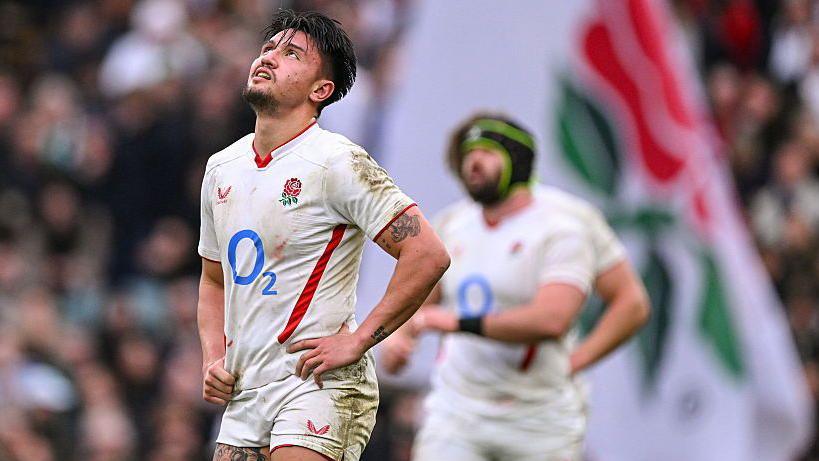 Image source, Getty Images
Marcus Smith's arrival as a first-half replacement for Freddie Steward against Ireland couldn't spark England into life against Ireland
By
BBC Sport rugby union news reporter
Don't believe the hyping. Or the sniping.
In the wake of England's 42-21 defeat by Ireland on Saturday, England head coach Steve Borthwick asked for some perspective.
"Two weeks ago, after 12 wins on the bounce, people were saying we were the best team in the world, and now we are all sorts of things," he told BBC Sport.
"Neither of these are true."
What is true though is that England's form has taken a sudden and pronounced downturn.
After a year-long winning streak, they have suffered back-to-back Six Nations defeats, having been swatted aside by Scotland at Murrayfield seven days before their trouncing by Ireland.
Why has England's bubble burst so emphatically?
This plea for the middle ground between praise and criticism is not something that England's coaching staff have invented to mitigate post-defeat criticism.
Even before the start of the tournament, they were attempting to temper some of the predictions that England were building into world-beaters.
Their 12-match winning streak may have over-inflated expectations.
It undoubtedly contained some impressive wins, last November's victory over New Zealand being the standout. There were also caveats, however.
The All Blacks put in a curiously listless performance and subsequently sacked head coach Brett Robertson.
A team weakened by British and Irish Lions selection won two Tests in Argentina, but the Pumas had taken the chance to rest some of their frontline names.
Wins over France and Scotland in last year's Six Nations could easily have crumbled in the opposite direction.
England did superbly in seeing off all comers in that run. But this Six Nations campaign has demanded more of them and they have been found wanting.
England gave themselves mountain to climb - Borthwick
2. Aerial rivals catch up with England
For much of 2025, it felt as if Borthwick had found an edge.
With a change in rules around the escorting of chasing players, the aerial contest opened up.
England were quickest to exploit it as a route deep into opposition territory, chasing hard, jumping high and claiming or batting back ball to exploit broken-field position.
However, no advantage lasts long unchallenged. Not in an era of analysis and number-crunching.
England's opposition has wised up.
Scotland and Ireland both fielded the backfield barrage, with catchers trumping England in the air and their energised team-mates well positioned to scoop up any loose-ball from spills.
With that tactic not bearing fruit, England either lacked a clear alternative or the nerve to switch to it mid-match.
Scotland made hay by moving the ball out wide and stretching England. Ireland punched holes through the middle and attacked with tempo and offloads.
Borthwick's side could not find their own style to fit the contest.
Ireland reignite title bid with record away win over England
England's case has not been helped by injuries. As they have chased high balls, they have been doing so with clipped wings.
Immanuel Feyi-Waboso, a threat on the ground and in the air, suffered a hamstring injury two days before the tournament opener against Wales. It is doubtful whether he will return before its end.
Tom Roebuck, another wing who prospers in the air, is only just back from a broken toe. He was brought back into action earlier than anticipated to cover Feyi-Waboso's absence, but his lack of preparation going into the tournament contributed to him missing the Ireland defeat.
Henry Arundell is the only wing to start all three games for England, but the 23-year-old Bath flier's game is more centred around his scorching pace.
A clumsy collision with opposite number Kyle Steyn while contesting a high ball in the Scotland defeat earned Arundell a 20-minute red card and cost England dear.
4. Fatigue catches up with England
Some of England's most trusted forwards looked tired in defeat by Ireland.
Captain Maro Itoje, who has been dealing with his mother's death as well as his usual sky-high workload, was withdrawn in the 55th minute of his 100th appearance for England.
Ellis Genge lacked his usual spiky physicality in the loose.
Tom Curry, usually a staple of England's best days and biggest occasions, was uncharacteristically quiet.
All three toured Australia with the British and Irish Lions in the summer.
Of course, so did 16 Ireland players.
But perhaps the workload, both physical and mental, is catching up with some of England's key men faster.
Wing Tommy Freeman revealed in the build-up to the Ireland game that his Northampton coaches had spotted that he was short of his usual intensity on his return from Australia and sat him out of training and matches for a while.
'Emotional' Dawson criticises England's mentality
5. Coaching visions take time to find focus
Borthwick reshuffled his coaching set-up after the summer, with senior assistant Richard Wigglesworth taking on the defence remit and Lee Blackett retained as attack coach after a successful stint in Argentina.
The one constant in Borthwick's time in charge has been change.
Wigglesworth follows Kevin Sinfield, Felix Jones, Joe El-Abd and Byron McGuigan (on secondment during last summer) as the fifth defence coach in less than three and a half years under Borthwick.
Getting the right men in place is key. But philosophy and plans, even if evolutions rather than revolutions, take time to bed in.